
Types of Solitaire Games: The Complete List
More than 500 types of solitaire games exist worldwide. From beginner-friendly Klondike to expert-level Forty Thieves, each variant has its own layout, movement rules, and win conditions.
Beginner games like Klondike and Tri-Peaks use a single deck with forgiving rules. Expert variants like Spider 4-Suit and Forty Thieves demand advanced planning across two full decks.
This guide covers 12 popular solitaire variations, organized by difficulty, with win rates and rules for each.
How Many Types of Solitaire Are There?
More than 500 recognized solitaire variations exist worldwide. The BVS Solitaire Collection catalogs over 570 distinct games. New variants continue to appear as players and designers create fresh layouts and rule sets.
Most of these games share a common goal: arrange cards into ordered sequences or Foundation piles. Foundations are the four piles built by suit from Ace to King. The differences come from the tableau layout, the number of decks, the movement rules, and the win conditions.
You do not need to learn all 500. About 10 to 12 types make up the vast majority of what people play online and with physical cards. This guide focuses on the solitaire games worth knowing, organized by difficulty level.
Beginner Solitaire Games
Beginner solitaire games use straightforward rules and a single deck. These five variants are ideal starting points for new players or anyone returning to the game after years away.
Klondike Solitaire (Turn 1 and Turn 3)
Klondike is the most widely played type of solitaire in the world. Most people mean Klondike when they say "solitaire." The name comes from the Klondike region of Canada, where gold rush miners played it in the 1800s.
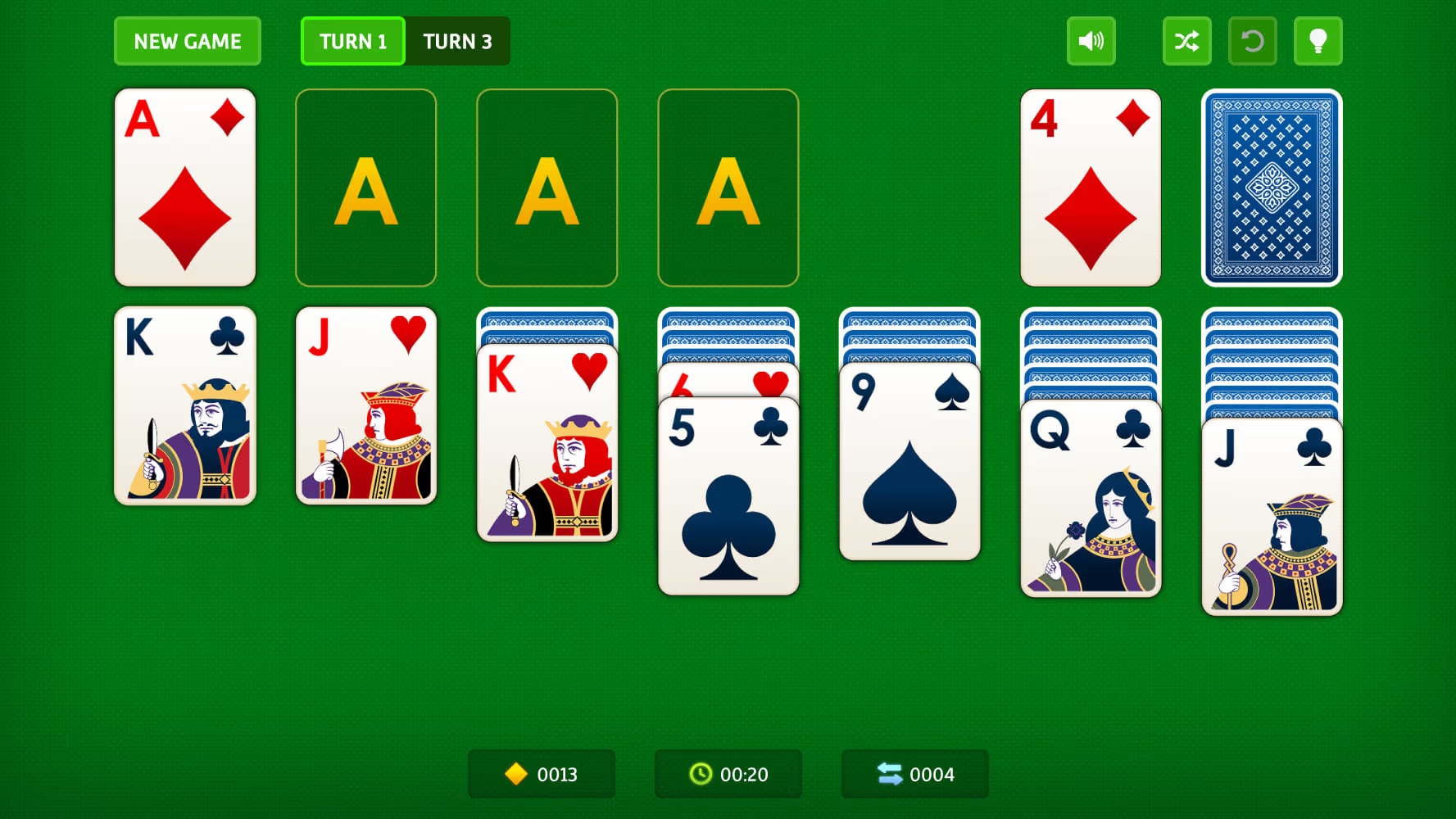
The layout uses a standard 52-card deck. The tableau (the main play area) has seven columns. Each column holds an increasing number of cards, with only the top card face-up. The remaining cards form the stock pile.
Your goal is to build four Foundation piles, one per suit, in order from Ace to King. Move cards between columns in descending order with alternating colors. For example, place the 7♥ on the 8♠.
In Turn 1, you flip one stock pile card at a time. In Turn 3, you flip three cards and can only play the top one. Turn 1 has a win rate of about 33%. Turn 3 drops to roughly 11% because fewer cards are accessible.
You can play Klondike Solitaire online at Solitaire.com for free, with no downloads required. The Hint button and Undo feature help beginners learn which moves work best.
Golf Solitaire
Golf Solitaire gets its name from the goal of finishing with a low score. It is one of the fastest solitaire types. Most games finish in under 10 minutes.
The tableau has seven columns, each with five face-up cards. The remaining cards form the stock pile, with the first card turned over to start the Waste pile (the discard area). Remove tableau cards that are one rank higher or lower than the top Waste pile card, regardless of suit. For example, a 6 or an 8 can go on a 7.
You can only pass through the stock pile once, so every card choice matters.
Tri Peaks Solitaire
Tri Peaks uses three overlapping pyramids of face-down cards with a connecting bottom row of face-up cards. Robert Hogue created this variant in 1989.
Like Golf, you match cards to the Waste pile card by one rank higher or lower. Each matched card becomes the new top of the Waste pile, creating chains. About 90% of Tri Peaks deals are winnable. That high rate makes this one of the most rewarding types of solitaire for beginners.
You can play Tri Peaks Solitaire at Solitaire.com. Test your streak in the Daily Challenge to build consistency.
Spider Solitaire (1-Suit)
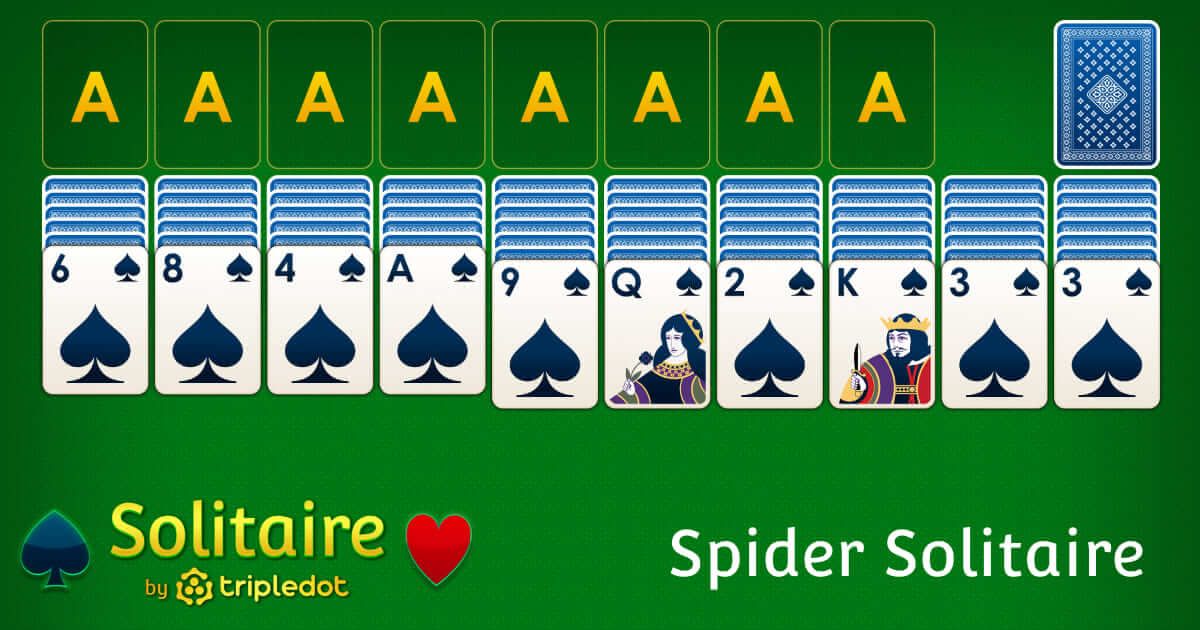
Spider Solitaire uses two full decks (104 cards) and ten tableau columns. The name comes from the eight Foundation piles you build, like the eight legs of a spider.
The 1-Suit version uses only Spades. Your goal is to build complete descending sequences from King to Ace within the tableau. A completed sequence moves automatically to a Foundation pile.
The first four columns each start with six cards. The remaining six start with five. Only the top card in every column is face-up. When you run out of moves, deal one card from the stock pile to each column.
With a win rate around 80%, this is an approachable introduction to Spider. For a deeper look, visit our Spider Solitaire game.
Intermediate Solitaire Games
Intermediate solitaire games add complexity through tighter movement rules, unique layouts, or fewer safety nets. These four variants reward careful planning and strategic thinking.
FreeCell Solitaire
FreeCell has the highest winnability of any popular solitaire variant. About 99.999% of all deals are mathematically solvable. Only one known deal, number 11,982, has no solution.
The tableau has eight columns with all cards dealt face-up. There is no stock pile. Instead, you get four free cells (temporary holding spaces) and four Foundation piles. Build Foundations by suit in ascending order from Ace to King.
Move cards between columns in descending order with alternating colors. Use the free cells to park cards that temporarily block your sequences. For example, move a 3♦ to a free cell so you can access the 4♣ underneath.
Empty columns and free cells are both valuable. Keep them open as long as possible. This is why experienced players win about 80% of their FreeCell games. Learn more in our complete FreeCell Solitaire guide.
Yukon Solitaire
Yukon looks similar to Klondike, with one critical difference: there is no stock pile. All 52 cards are dealt to the tableau at the start. The seven-column layout mirrors Klondike, but more cards begin face-up.
You can move groups of cards between columns even when they are not in sequence. The top card of the group must follow the alternating-color, descending-order rule. This flexibility gives Yukon a more strategic feel than Klondike.
The win rate is about 25%. Most games take 15 to 20 minutes.
Pyramid Solitaire
Pyramid Solitaire arranges 28 cards in a pyramid shape with seven overlapping rows. All tableau cards are face-up. The remaining cards form the stock pile.
The rules differ from most types of solitaire. Instead of building sequences, you pair two cards whose values add up to 13. Jacks count as 11, Queens as 12, and Kings equal 13 on their own. For example, pair a 9 with a 4. Remove a King by itself.
A card is only playable when no other cards overlap it. Pyramid has one of the lowest win rates among popular solitaire games, at roughly 1-2%. Read the complete rules in our Pyramid Solitaire guide.
Spider Solitaire (2-Suit)
Spider 2-Suit adds a second suit to the standard Spider layout of 104 cards and ten columns. Usually, Hearts join Spades. Building same-suit sequences becomes significantly harder when two suits appear in every column.
You must create complete same-suit runs from King to Ace to clear them to a Foundation pile. Mixing suits in a column blocks movement. The win rate drops to about 35%.
Expert Solitaire Games
Expert solitaire games demand patience, foresight, and careful decision-making. Expect lower win rates and longer sessions. Even experienced players lose more often than they win.
Forty Thieves
Forty Thieves is one of the most challenging types of solitaire. Legend says Napoleon played this game during his exile on Saint Helena. It uses two full decks (104 cards).
The tableau has 10 columns, each with 4 face-up cards. That makes 40 starting cards, hence the name. The remaining 64 cards form the stock pile. You can only move one card at a time, and sequences must follow the same suit in descending order.
You pass through the stock pile only once. This strict rule makes every decision critical. The win rate for experienced players is around 10%.
Scorpion Solitaire
Scorpion uses a single 52-card deck, with seven columns of seven cards each. The first three columns have three face-down cards at the top. The remaining four columns are fully face-up.
Your goal is to build four same-suit sequences from King to Ace within the tableau. You can move any face-up card along with every card below it, even when they are not in order.
The three remaining cards form a small reserve for later. The win rate is approximately 20%.
Spider Solitaire (4-Suit)
Spider 4-Suit is the hardest Spider variant. All four suits are in play across 104 cards and ten columns. Building same-suit sequences from King to Ace becomes extremely difficult when four different suits appear in every position.
The win rate drops below 10%. Games often take 20 to 30 minutes.
Canfield Solitaire
Canfield started as a casino game in the 1890s. Richard Canfield ran a gambling house in Saratoga Springs, New York, where players wagered on the game.
A random card determines the starting rank for Foundations. You build up by suit from that card, wrapping from King back to Ace when needed. The tableau has only four columns. A reserve pile of 13 cards adds to the difficulty.
This combination of a small workspace and a random starting point makes Canfield unpredictable. Win rates range from 5 to 10%.
Regional and Unique Solitaire Variants
Solitaire has a rich global history with dozens of regional variations beyond the 12 popular games listed above.
Chinese Solitaire uses one or two decks with ten tableau columns. It follows a strict rule: only one card moves at a time unless you build a perfect same-suit sequence. Clock Solitaire (also called Clock Patience) arranges 13 piles of four cards in a clock-face pattern. It is almost entirely luck-based.
Crescent Solitaire uses two decks, arranged in a crescent shape with 16 piles. You build eight Foundation piles in two directions: four ascending and four descending. This dual-direction mechanic creates a distinctive puzzle.
Which Type of Solitaire Should You Play?
The best solitaire game depends on what kind of experience you want.
If you are new to solitaire, start with Klondike Turn 1. It teaches the fundamentals of sequencing and Foundation building. The built-in Hints and Undo make learning easier.
If you enjoy planning several moves, try FreeCell. It's a near-perfect winnability rewards strategy over luck.
If you want a quick game, Golf and Tri Peaks both finish in under 10 minutes.
If you want a serious challenge, Forty Thieves and Spider 4-Suit test patience and foresight. These games have win rates under 10%, so every move counts.
Solitaire.com offers free online play with classic scoring, no downloads, and a Daily Challenge to keep your skills sharp.
Frequently Asked Questions
What is the easiest type of solitaire?
Tri Peaks Solitaire has the highest win rate among popular variants at roughly 90%. Its rules are simple: match cards of the same rank or one rank higher or lower. Spider 1-Suit is another beginner-friendly option with an 80% win rate.
What is the hardest type of solitaire?
Forty Thieves and Spider 4-Suit are consistently the hardest. Both have win rates below 10% and require long-term planning across large tableaux with strict movement rules.
Is every deal of solitaire winnable?
No. Winnability depends on the variant and the specific card deal. FreeCell comes closest at 99.999% winnable. Klondike is about 82% theoretically winnable, though most players win roughly 33% of Turn 1 games.
What is the difference between solitaire and patience?
Solitaire and patience refer to the same family of single-player card games. "Solitaire" is the standard term in North America. "Patience" is common in the United Kingdom and Europe.
Can I play different types of solitaire online for free?
Yes. Solitaire.com offers Klondike, Spider, Tri Peaks, Pyramid, FreeCell, and more. All games are free with no downloads. Features include Undo, Hints, and classic scoring.
How many cards does Spider Solitaire use?
Spider Solitaire uses two standard decks for a total of 104 cards. These are dealt across ten tableau columns. The number of suits (1, 2, or 4) determines the difficulty.