
How to Win Solitaire: Best Solitaire Strategy & Tips
Solitaire is a timeless card game that has fascinated players for centuries. Whether you're seeking a mental challenge, a satisfying daily routine, or just a calming break, solitaire offers endless strategic depth. With so many solitaire variations available to play online today, there is always a fresh puzzle waiting for you.
After mastering the rules and playing many sessions, most players notice improvement, but how to win solitaire consistently? Is it possible to win every time?
This guide breaks down the best solitaire strategy, solitaire tips, and advanced insights you can use immediately to boost your win rate.
Key Takeaways
- Solitaire is a popular strategy card game first mentioned in a German game anthology in the 18th century.
- Patience and careful planning are essential for success in any solitaire game.
- Your strategy needs to be adjusted to the particular variety of the game you are playing.
- While playing solitaire online, use tutorials, hints, and the undo button strategically. You can also track your progress and customize your gameplay for the best experience.
- Solitaire is a great mental challenge, and whether you win or not, it helps improve your focus and problem-solving skills.
The Historical Context of Solitaire
Solitaire most likely originated in Germany or Scandinavia. Its first recorded mention comes from the German book Das neue Königliche L'Hombre-Spiel, an anthology with rules for various games. There is a chapter called Patience (an alternative name for this game still used in Europe), which describes it as a game between two players who take turns.
Then it evolved into a strategic one-player card game said to have been enjoyed even by Napoleon in his exile. Apart from the standard game, there are now over 500 variants, so you can constantly explore new challenges with different layouts and rules.
Some of them became popular when they were added to Microsoft Windows, and now, you can play most of the popular solitaire varieties online.
How to Win Solitaire: Best Tips for All Variants
Across all solitaire variations, the most universal rule is embedded in the European name for the game: Patience. A great solitaire strategy is slow, deliberate, and thoughtful. Rushing leads to blocked columns, missed sequences, and unwinnable layouts.
Below are the best strategies tailored to each major solitaire style.
Tips for Solitaire Games
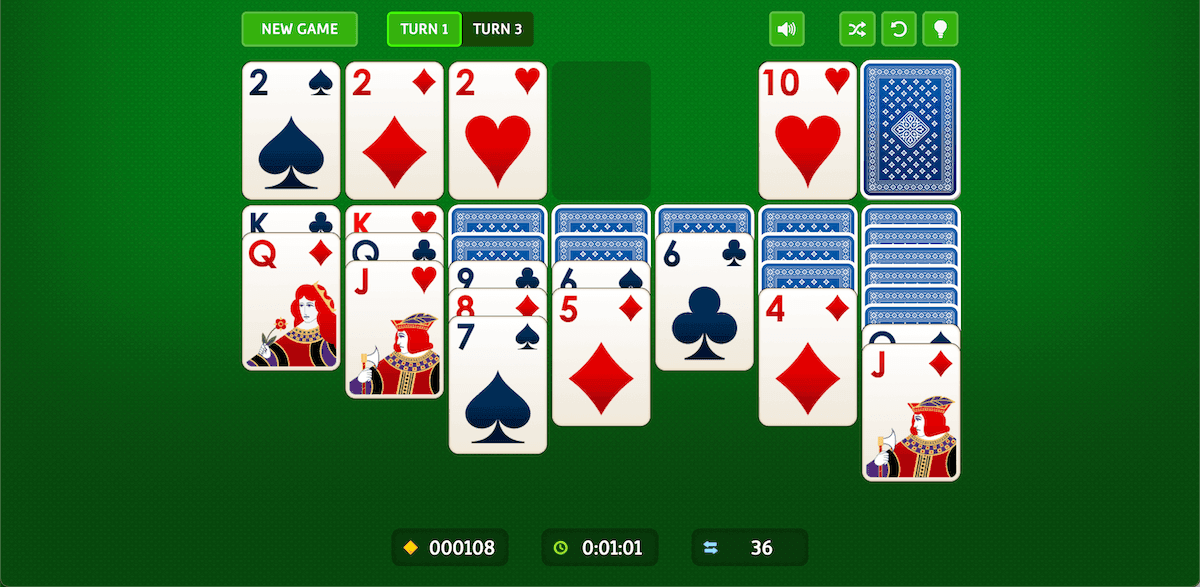
Take a look below for more solitaire tips adjusted for particular variants of the game:
Klondike Solitaire
Klondike Solitaire is the alternative name for the traditional solitaire game. It is played with a single deck of 52 cards, dealt into seven columns.
The objective is to build four foundation piles by suit, starting with the Ace and ending with the King. Cards in the tableau can be arranged in descending order and alternating colors.
Klondike Solitaire Step-by-Step Guide

- Deal seven columns, with one card face-up in the first column, two in the second (with one face-up), and so on.
- Start by moving cards from the tableau to build descending sequences by alternating colors (red/black).
- Transfer cards to the foundation piles, beginning with the Aces.
- Use the stockpile to bring new cards into play and clear the tableau.
- The game is won when all four foundation piles are built up from Ace to King.
Strategies and Tips for Klondike Solitaire
-
Essential Klondike Solitaire Strategy & Tips
-
1. Prioritize revealing hidden cards
-
If you have two possible moves, always choose the move that reveals a card. Every face-down card represents potential mobility-or a potential trap.
-
2. Know when to move cards to the foundation
-
Not every card should be rushed to the foundation, but knowing which ones are safe makes a big difference. Aces should always go to the foundation immediately, they have no tableau-building value.
-
Twos are almost always safe to send up as well, since only Aces can be placed on them in the tableau, and those should already be in the foundation.
-
The real caution starts with 3s through 5s. These mid-low cards are often needed for building alternating-color sequences.
-
Before sending a 3, 4, or 5 to the foundation, check whether you still need it to hold a tableau sequence together. Also, try to build your foundation piles evenly across all four suits, racing one suit far ahead can trap cards you need in the tableau.
-
3. Never empty a tableau pile unless you can place a King there
-
An empty column is powerful, but only with a King.
If you empty a column with no King available, you create a dead zone. -
4. Tableau moves > Stockpile moves
-
Beginners overuse the stockpile.
Experts mine the tableau first because stock flips are limited.
Focus on the tableau movements: Before you use the stockpile, make absolutely sure you can't progress your game within the tableau. Leave the stockpile for the moments when you're stuck.
Concrete Example: Reveal vs Build
Imagine this tableau:
Column A: 10♠ (face up), 9♥ (face down)
Column B: 10♦ (face up)
Column C: 9♣ (face up)
You can either:
Option 1: Move 9♣ → 10♦
Option 2: Move 10♠ → empty column (if available) to reveal 9♥
Correct answer:
Option 2-reveal the hidden card.
Revealing hidden cards ALWAYS increases long-term win probability.
Turn 1 vs. Turn 3 Solitaire Strategy
One of the most important variations in Klondike Solitaire is whether you're playing Turn 1 (also called Draw 1) or Turn 3 (Draw 3). This changes your entire approach to the game.
Turn 1 Solitaire (Draw 1)
In Turn 1, you flip one card at a time from the stockpile. This gives you complete visibility and control.
Strategy for Turn 1:
- You can see every card in the stock, so plan multiple moves ahead
- Focus heavily on tableau building since you have guaranteed access to stock cards
- Moving cards to foundations earlier is safer because you can always retrieve stockpile cards
- Win rate is significantly higher (50-60% for experienced players)
- Take your time analyzing all options before each stock flip
Turn 3 Solitaire (Draw 3)
In Turn 3, you flip three cards at a time, but can only play the top card of each group. This is the traditional solitaire strategy, 3-card draw that most players know from classic computer versions.
Strategy for Turn 3:
- Pay attention to the rhythm of the three-card groups
- Before dealing from the stock, exhaust all possible tableau moves
- Remember which cards are "locked" behind others in the three-card sequence
- Be more conservative about moving cards to foundations (you might need them and can't easily get stock cards back)
- Empty columns are more valuable since stock access is limited
- Win rate drops to 35-40% even for skilled players
Key Difference:
The solitaire strategy 3-card draw requires much more patience and planning. You must think about card accessibility, not just card sequence. A card buried third in a group might as well not exist until you cycle through the entire stock.
Which Should You Play?
- Turn 1: Better for learning, higher win rates, more relaxing
- Turn 3: Traditional challenge, requires advanced planning, more strategic depth
Most online solitaire games let you choose between Turn 1 and Turn 3, so experiment with both to find your preferred challenge level.
Advanced Klondike Strategy Tips
Build Tableau Piles Evenly Avoid stacking too many cards on a single column. Balanced tableau columns give you more flexibility and increase your chances of freeing Kings and uncovering hidden cards.
Choose Kings Wisely When you have more than one King available to place in an empty column, pick the one that uncovers the most hidden cards. Prefer Kings with long, alternating-color sequences already attached. Avoid placing a King that will create a short or dead-end stack.
Use the Waste Pile as Strategic Storage Especially in Turn 3 (Draw 3), pay attention to the order of cards in the waste pile. Keep useful mid-range cards (6s through 9s) accessible rather than burying them in the tableau. Cycle the stock deliberately and avoid making moves just for the sake of it.
Think in Reversals Before making any move, ask yourself: "Can I undo this later if it turns out to be wrong?" If the answer is no, proceed with extra caution. Reversible moves preserve your options; irreversible ones can lock you into a losing position.
Build Foundations Evenly Don't race one suit far ahead of the others. Uneven foundation piles can trap cards you need for tableau sequences. Try to keep all four foundation piles within one or two ranks of each other.
Spider Solitaire
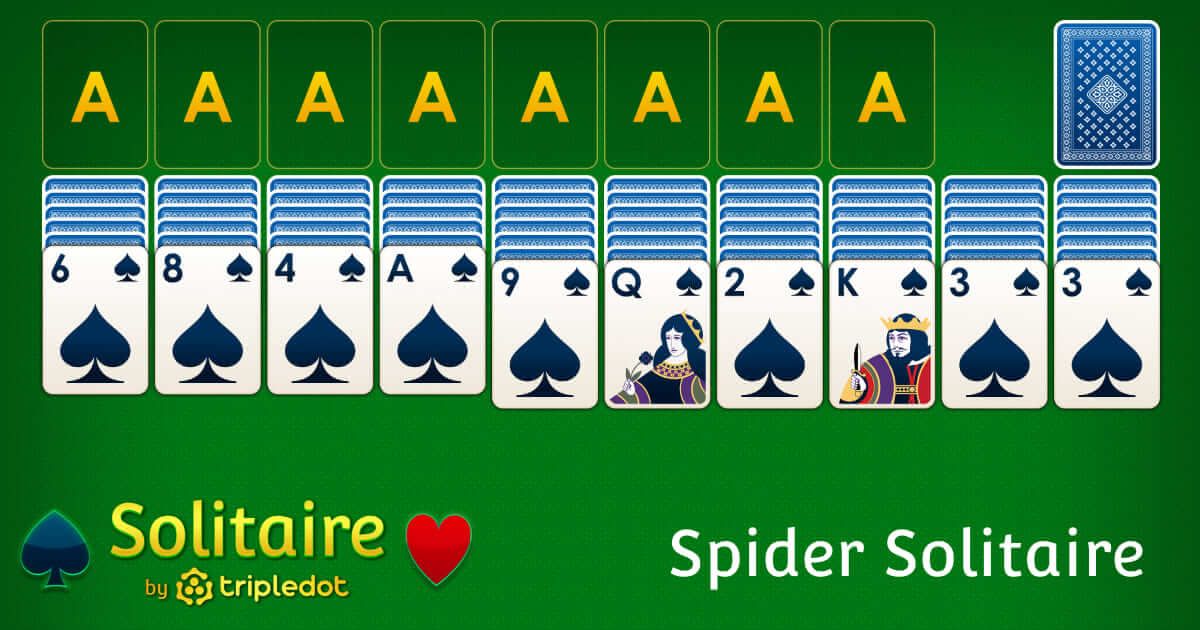
Spider Solitaire is a much more complex variation, typically played with two decks of cards. Unlike Klondike, all cards are dealt face down in the tableau except for the top one.
The goal is to build complete sequences of cards in descending order from King to Ace, all in the same suit. When a sequence is completed, it is removed from the tableau. Spider Solitaire is known for its strategic depth, requiring careful planning.
Spider Solitaire Step-by-Step Guide
- Deal 10 columns with five cards face down in each, except for the top card in each column, which is face-up.
- Move cards between columns to build descending sequences, regardless of suit.
- Aim to complete sequences of the same suit to clear them from the tableau.
- When no moves are available, deal an additional row of cards from the stockpile.
- The game is won when all eight sequences (if playing with two decks) are completed and removed.
Strategies and Tips for Spider Solitaire
- Empty columns quickly: One of the most crucial strategies in Spider Solitaire is creating empty columns as early as possible. They will allow you to reorganize the tableau and temporarily store cards, making it easier to complete suit sequences.
- Build in full suits: Whenever possible, build your sequences in the same suit. This makes it easier to move sequences to different columns and eventually complete a full sequence to clear it from the tableau.
- Create mixed sequences on higher ranks to reveal more cards: If you can't build sequences in the same suit, create mixed ones to make it possible to unfold hidden cards.
Prioritize uncovering cards: Revealing cards will give you more movement opportunities, so if you have multiple options to move, choose the one that will eventually help you uncover the highest number of cards.
FreeCell Solitaire
FreeCell Solitaire is another popular variation in which every card is dealt face-up, so luck plays no role and success depends solely on strategy.
The objective is similar to Klondike: build four foundation piles by suit, but FreeCell adds a twist by providing four empty "free cells" that can temporarily hold cards to facilitate moves. This gives the player greater flexibility but requires careful planning.
FreeCell Solitaire Step-by-Step Guide
- Deal all cards face-up in eight columns.
- Use the free cells to temporarily hold cards while rearranging the tableau into descending sequences by alternating colors.
- Build foundation piles in the top right, starting with Aces.
- The goal is to clear the tableau by transferring cards to the foundation piles.
Strategies and Tips for FreeCell Solitaire
- Use free cells wisely: To maximize your options, aim to keep as many free cells open as possible. Filling up all free cells too early can severely limit your ability to move cards and create new sequences.
- Prioritize lowering high cards: High cards like Kings, Queens, and Jacks can often block smaller cards from being moved. Focus on creating empty spaces and moving these higher cards first, as they will allow you to free up lower-ranked cards for sequencing.
- Maximize tableau space: Just as in Spider Solitaire, empty columns are very helpful in FreeCell. Try to create empty tableau columns early in the game, as they provide flexibility in moving large sequences of cards.
- Think several moves ahead: Always consider the implications of your actions on future moves. Before you make a move, think about how it will affect the overall game and your ability to free up additional cards.
Move Aces and Twos to the foundation early, but be strategic with higher cards: Aces and Twos rarely help in the tableau, so send them up right away. However, be cautious with 3s and above. You may still need them for building sequences. Build foundation piles evenly across suits to avoid trapping needed tableau cards.
Tips for Playing Solitaire Online
Nowadays, you don't need physical cards to play solitaire. You can find games that convert multiple variants of this game into digital form and play them in your browser or app, anywhere you are.
Here are some tips for online solitaire:
- Start with tutorials: Beginners should start with tutorials to familiarize themselves with the specific rules of each variation. Even experienced players can benefit from refreshing their knowledge of the rules if they haven't played a particular game for a while.
- Use in-game hints when you're stuck: Many online Solitaire games include hints that show you potential moves. While you shouldn't rely on them too much, they can be a helpful way to spot opportunities you might otherwise overlook.
- Monitor your win rate: Watching your win rate can help you understand how well you're playing and where you can improve. If your win rate is low in a specific variation, focus on refining your strategy for that game, or switch to a different one.
- Choose a suitable interface: Find card designs and backgrounds that are visually comfortable for you. A clean, clutter-free design can help you focus on the game without distractions.
- Use the undo button strategically: While it's tempting to undo every mistake, use it as a learning tool. See how far you can go without needing it, but don't hesitate to go back if you're really stuck.
Can You Always Win at Solitaire?
Many players wonder whether solitaire is always winnable.
The answer: It depends on the version.
Classic Klondike (solitaire)
- Only ~80% of games are mathematically winnable.
- The average player wins about 35-40% of games.
Having a good strategy raises your win rate, but you cannot win every single game.
Spider Solitaire
- 1 Suit: ~20-25% win rate
- 2 Suit: ~12-15%
- 4 Suit: <10%
This variation is intentionally difficult.
FreeCell
- 99% of all deals are solvable.
If you want the closest thing to "how to win solitaire every time," FreeCell is the answer.
So can you win every game?
Only in FreeCell (with perfect play).
In all other versions, luck affects the initial layout.
Common Mistakes That Prevent Wins
These errors dramatically reduce your win rate:
Moving cards to the foundation too early
Aces and Twos are almost always safe to send up immediately, but moving 3s through 7s too soon can block needed tableau sequences. Build foundations evenly across all four suits to keep your options open.
Using empty columns incorrectly
Never leave an empty column unused-place a King immediately.
Not prioritizing hidden cards
Every face-down card is a solution waiting to be unlocked.
Dealing new cards too early in Spider
This can bury good sequences.
Not thinking ahead in 3-card-draw solitaire
Turn 3 requires rhythm awareness-not impulse moves.
Filling free cells too soon (FreeCell)
Empty cells = power.
The Bottom Line
We hope that using our solitaire tips will help you make the gameplay even more enjoyable and stimulating, and eventually make more sessions successful. However, take into account that even if you don't win, solitaire is a great exercise for your brain, so it's never a waste of time. If one variation is too easy or too hard for you, you can always search for other versions to find your favorite. Browse through our website or download our mobile app to play solitaire conveniently wherever you are!