
How to Play Spider Solitaire: Rules, Setup & Tips
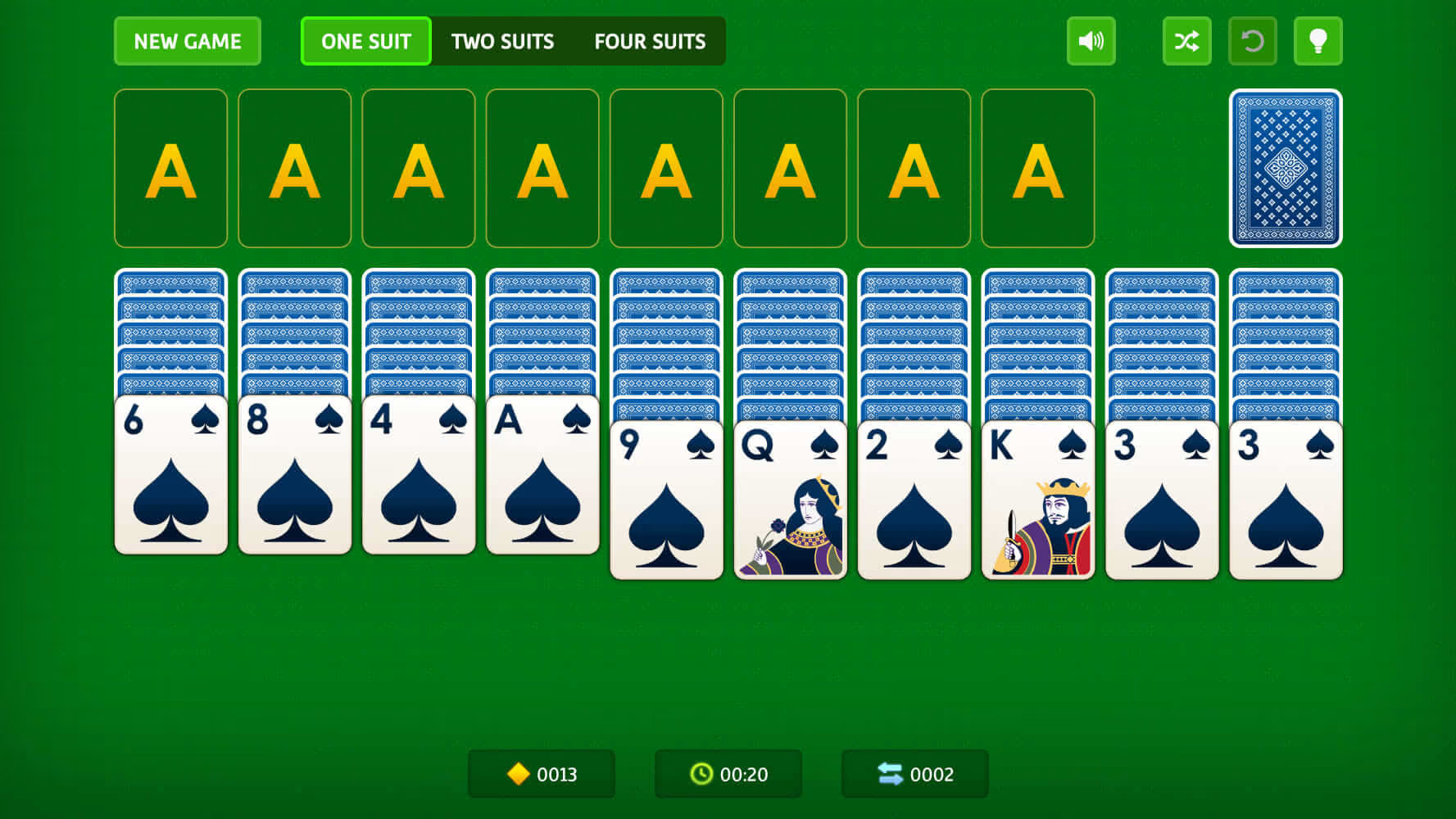
Spider Solitaire is a single-player card game that uses two full decks (104 cards) and challenges players to build sequences from King to Ace in the same suit. The game became a global sensation after its debut on Windows 98 and later Windows XP, where it quickly became one of the most-played built-in games of all time. It offers three difficulty levels (1 Suit, 2 Suits, and 4 Suits), making it accessible for beginners while offering serious challenges for experts.
What Is Spider Solitaire?
Spider Solitaire is a single-player card game that uses two full decks (104 cards) and challenges players to build sequences of cards in descending order from King down to Ace. Unlike Classic Solitaire (Klondike), Spider does not require alternating colors, unless you're playing the hardest mode.
The game became a global sensation when Microsoft introduced it in Windows 98 and later made it the star of Windows XP. The digital version standardized the game into three difficulty levels:
- 1 Suit (Easiest)
- 2 Suits (Medium)
- 4 Suits (Hardest)
Today, Spider Solitaire remains one of the most popular patience games thanks to its relaxing pace, high strategy, and satisfying feeling of clearing full suit sequences.
Spider Solitaire Setup
Understanding the setup is crucial. The game looks deceptively simple at first, but its layout silently dictates every choice you will make. Those ten tableau columns define how flexible your moves will be, how quickly you can uncover hidden cards, and how efficiently you can build the long suited sequences needed to clear the board. Even the initial distribution of face-down cards can shape the pace and difficulty of your game. A player who studies the layout carefully gains an immediate strategic advantage, spotting patterns, predicting bottlenecks, and planning several steps ahead. In Spider Solitaire, the setup isn't just the beginning; it's the blueprint for your entire strategy.
The Tableau Layout
Spider Solitaire uses 10 tableau columns, which contain all cards in play.
Here's how the initial 54 cards are dealt:
- 4 columns get 6 cards each
- 6 columns get 5 cards each
- Only the top card of every column is face-up
This leaves 50 cards in the stockpile, which you will deal 10 at a time during gameplay.
Full Setup Summary
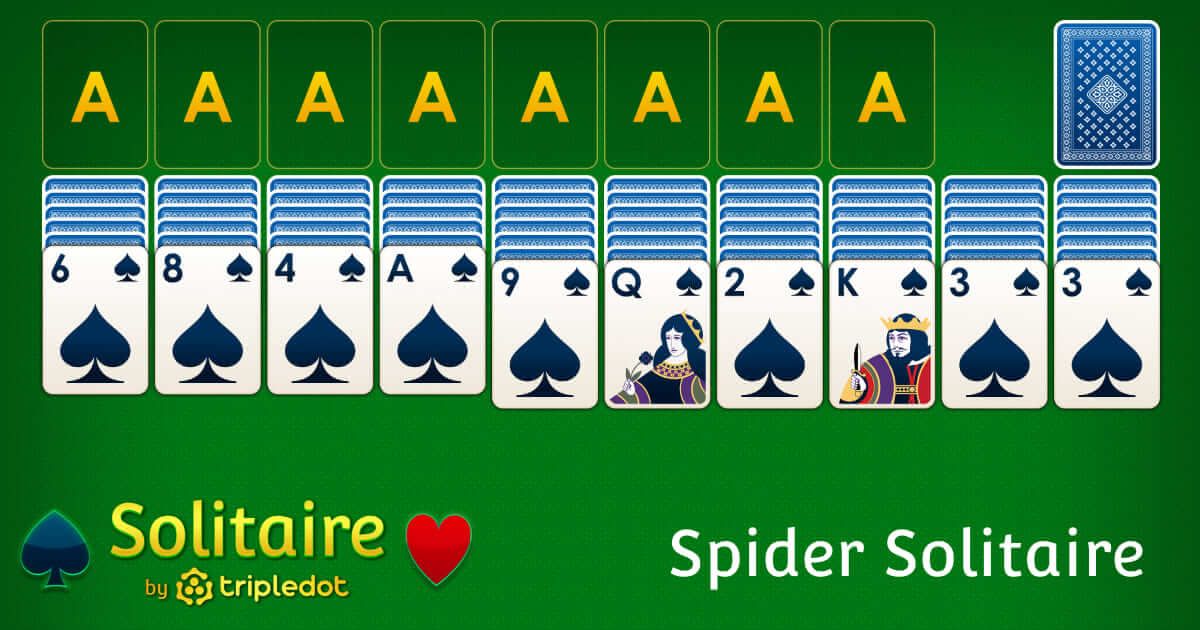
- Total Cards: 104 (two decks)
- Cards Dealt to Tableau: 54
- Stockpile: 50 cards (5 rows of 10 cards)
- Columns: 10 tableau columns
- Face-up Cards: Only the top card of each column
The tableau is where all strategy happens. You will be rearranging cards here until you complete suit sequences.
How to Play Spider Solitaire
The rules of Spider Solitaire look simple, but they open up countless strategic possibilities. Here's a clear breakdown:
Objective of the Game
The goal is to create complete descending sequences within the tableau:
King → Queen → Jack → … → 2 → Ace (all in the same suit)
Once a full sequence is formed, the game automatically removes it from the tableau.
To win, you must clear all eight suit sequences (since there are 104 cards).
How Card Movement Works
Moving Individual Cards
You can place a card onto any other card that is one rank higher, regardless of suit.
Examples:
- 7♦ can be placed on 8♠
- 10♣ can be placed on J♥
- Ace cannot be placed on anything
In Spider Solitaire, colors don't matter unless you're in the 4-Suit variant.
Moving Ordered Runs
If you have a sequence of cards in perfect descending order, and all of them are the same suit, you may move the entire stack together.
Example of a movable run:
9♠-8♠-7♠-6♠
Example of a run you cannot move as a single stack:
9♠-8♠-7♦-6♠ (mixed suits break the chain)
You can move partial stacks (e.g., 9♠-8♠) if they maintain proper order and suit.
Revealing Cards
Whenever you clear or move cards from the top of a pile and expose a face-down card, that card flips over.
Uncovering cards early is one of the strongest strategies in the game.
Using the Stockpile
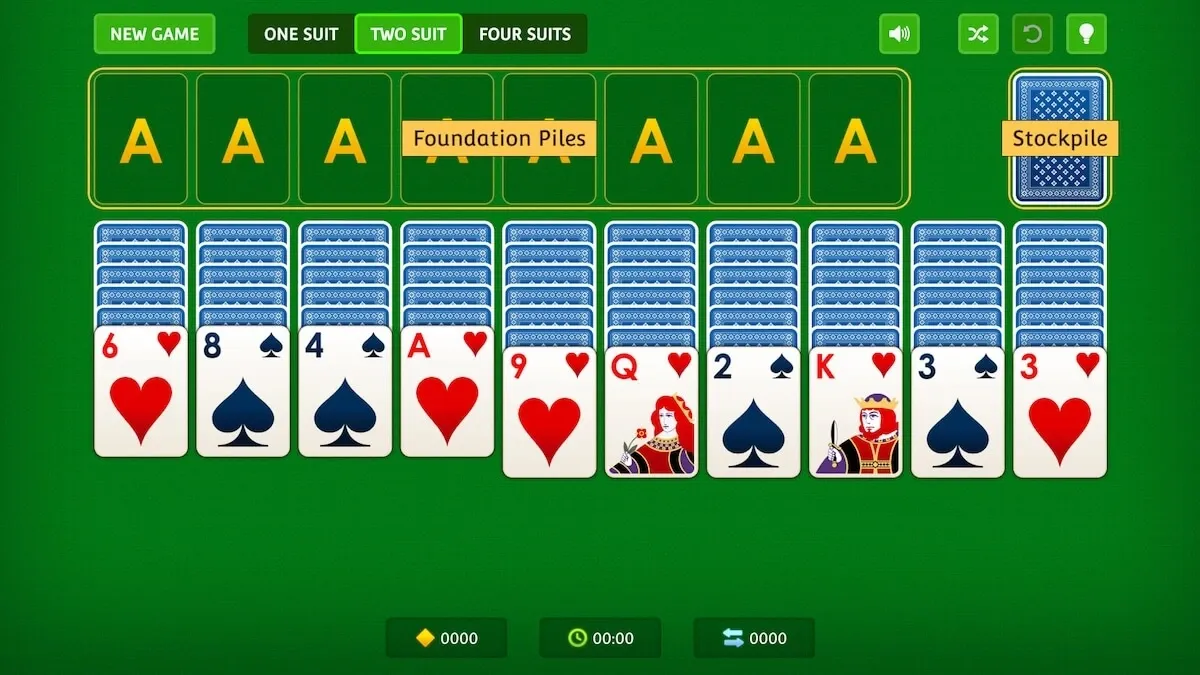
The stockpile contains five rows of 10 cards each. Every time you click the stockpile:
- 10 new cards are added-one to each tableau column.
- You must have no empty columns to deal (Windows rules).
- These new cards may block sequences, so deal only when necessary.
Stockpile deals usually make the game harder before it becomes easier.
Completing Suit Sequences
Only when you create a complete run K → A in the same suit will the game remove it from the board.
You must complete 8 total sequences (2 decks × 4 suits) to win.
Spider Solitaire Difficulty Variants Explained
Spider Solitaire has three official difficulty levels. Win rates vary dramatically depending on the number of suits used.
1 Suit Spider (Easiest)
- Uses only spades
- All sequences are the same suit, so the stacks move easily
- Most forgiving version
Estimated Win Rate: ~80% for practiced players
Who should play it: Beginners, casual players, puzzle relaxers
2 Suit Spider (Moderate Difficulty)
- Uses spades and hearts
- Half of your runs break due to mismatched suits
- Requires careful stack planning
Estimated Win Rate: ~35-50%
Who should play it: Players ready for more challenge
4 Suit Spider (Hardest Version)
- Uses all four suits
- Very difficult to create long same-suit sequences
- Requires deep planning, patience, and precise play
Estimated Win Rate: <10%
Who should play it: Experts and strategy lovers
Gameplay Example: Revealing Cards vs. Building Early
Here's a simple example of the kind of decision-making Spider Solitaire requires.
Situation
You have two choices:
Move A: Build a longer visible sequence (e.g., adding 7♠ onto 8♠)
Move B: Break that sequence to uncover a face-down card beneath a different pile
Correct Strategy
In most cases, revealing new cards is more valuable than strengthening existing runs.
Face-down cards can hide Kings, crucial connectors, or entire workable stacks.
This is why uncovering the tableau is your #1 long-term objective.
Beginner Tips to Improve Your Spider Solitaire Wins
Here are five of the most important strategies for newer players-essential habits that can dramatically improve your chances of winning. While Spider Solitaire may seem like a simple game of placing cards in descending order, the truth is that every move has consequences. These strategies will help you understand the deeper logic of the game, enabling you to read the tableau, plan ahead, and keep your piles flexible as stockpile cards come into play.
Tip 1: Empty Columns Are Your Greatest Weapon
An empty tableau column allows you to:
- Move long stacks
- Temporarily store cards
- Rebuild clean same-suit sequences
Try to create your first empty column as early as possible.
Tip 2: Always Prioritize Flipping Face-Down Cards
Every hidden card creates uncertainty.
The more cards you reveal, the more control you gain over the tableau.
Tip 3: Build Pure Suit Runs Whenever Possible
Even though you can stack on any suit, mixed stacks will:
- Block big movements
- Trap cards
- Reduce flexibility
Pure suited runs allow smooth, large moves, vital for winning.
Tip 4: Think Ahead Before Dealing Stock Cards
Dealing cards too early can bury your clean sequences under unhelpful cards.
Only deal stock when:
- You have run out of moves
- You have organized the tableau enough to handle new cards
Tip 5: Undo Is a Tool-Use It Strategically
Many digital versions allow unlimited Undo.
Use it to:
- Test different strategies
- Explore alternative sequences
- Re-evaluate major decisions
It's not cheating; it's learning.
Summary of the Rules (Quick Reference)
- Objective: Build 8 full K→A sequences of the same suit
- Decks: 104 cards (two decks)
- Setup: 10 tableau columns, 54 cards dealt
- Stockpile: 50 cards, dealt 10 at a time
- Moves Allowed: Card onto next-higher rank (any suit)
- Sequence Moves: Only same-suit runs move together
- Win Condition: Remove all 8 sequences
Why Spider Solitaire Is So Popular
Spider Solitaire remains beloved because it offers:
- Deep strategy and long-term planning
- Relaxing puzzle-solving
- High replayability
- A difficulty curve suitable for all levels
- A sense of accomplishment when sequences disappear
1-Suit offers instant accessibility.
4-Suit offers world-class difficulty.
And 2-Suit sits perfectly between them.
No matter your skill level, the game grows with you.
Conclusion
Spider Solitaire may seem intimidating at first, but once you understand the setup, rules, and strategic foundations, it becomes one of the most rewarding solitaire games ever created. Its digital rise through Windows 98 and XP brought millions of new players into the world of patience games, and today it continues to thrive by challenging the mind while offering calm, thoughtful gameplay.
Master the basics, start with 1-Suit for practice, and slowly build up to the tougher variants. With patience, clever planning, and a bit of experimentation, you'll soon find yourself clearing full sequences, creating empty columns with ease, and discovering the uniquely satisfying rhythm of Spider Solitaire.