
Forty Thieves Strategy: How to Win One of Solitaire's Hardest Games
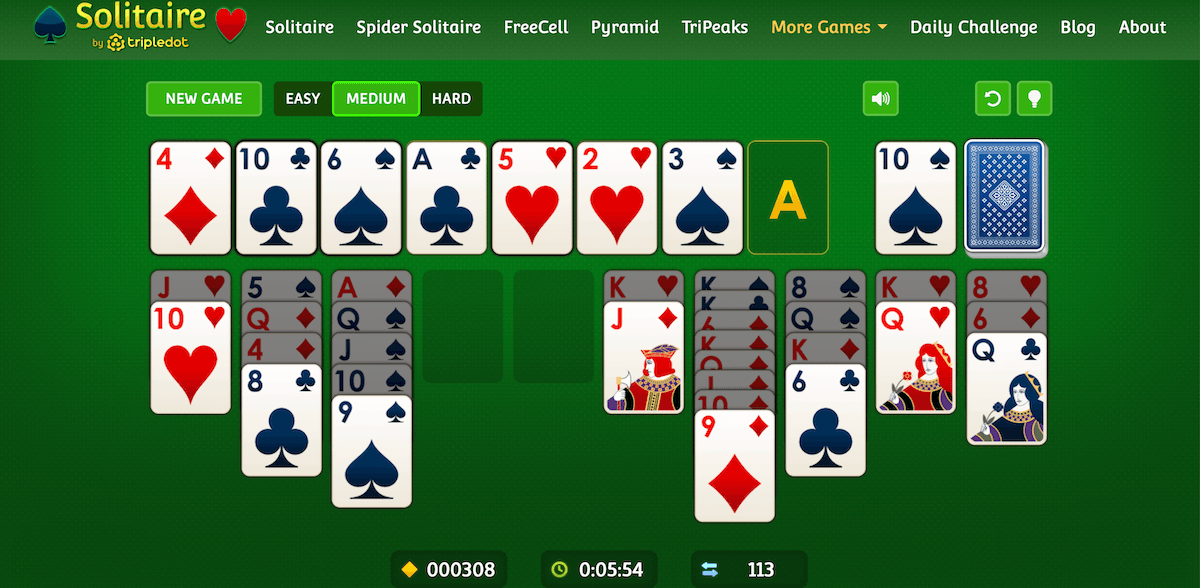
Forty Thieves Solitaire is a tough two-deck game because every card is visible, yet almost nothing can move freely. This guide assumes you already know how to play Forty Thieves and focuses on the strategy that turns a losing deal into a win. Empty columns, stock pile discipline, and tracking duplicate cards decide almost every game, and the right priority changes as play moves from opening to endgame.
Why Forty Thieves Solitaire Is Hard to Win
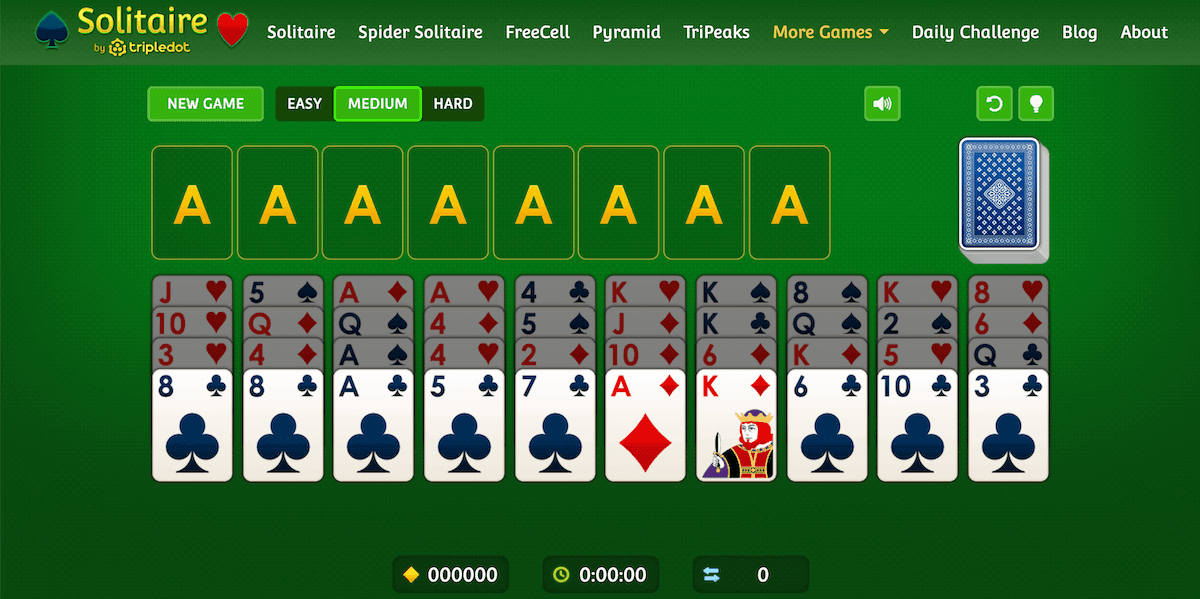
Two decks deal ten columns of four face-up cards, and the remaining 64 form the stock pile. Klondike hides 21 of its 52 cards, so its difficulty is informational. Forty Thieves shows you the whole tableau, then restricts what you may do with it: the tableau builds down in suit, one card at a time. The 9♠ moves onto the 10♠, but not onto the 10♣ and not onto the 10♥.
Red-on-black building gives a Klondike card four landing spots per rank. Forty Thieves gives it one. Community estimates place the casual player win rate between 3% and 7%, and the skilled player win rate between 10% and 15%. Klondike carries a solvability rate of 81.945%, according to Blake and Gent in the Journal of Artificial Intelligence Research, 2026.
Empty Columns Decide Most Forty Thieves Games
Because you move one card at a time, a blocked card has nowhere to go unless a same-suit base exists or a column stands empty. An empty column accepts any card, which makes it the only universal landing spot. Ranked, use one to:
- Empty a second column. Unloading a short column into space you already own compounds the advantage.
- Dig out a buried 2 or 3 that unlocks a foundation.
- Hold a waste pile card with no tableau base, keeping the stock pile moving.
- Park a card while you merge two same-suit runs.
Filling an empty column with a King ends most games. The K♠ accepts the Q♠ and nothing else, so if neither Q♠ is reachable, the column is dead. Target the shortest columns instead.
Forty Thieves Stock Pile and Waste Pile Strategy
Sixty-four of the 104 cards sit in the stock pile, so most of the deal turns on cards you cannot see. Each draw buries the card beneath it: if the 6♥ lands above the 5♥, the 5♥ stays unreachable until the 6♥ moves. Classic rules permit one pass, so play as though it is final. Ranked stock pile rules:
- Exhaust the tableau first. Draw only when no tableau move keeps your options open.
- Play the waste pile card immediately when a same-suit base exists, because the next draw buries it.
- Read one card ahead. Ask which card you could not place, then clear a base for it.
- Never draw to escape a decision. A draw made because the board looks stuck usually buries the card that would have unstuck it.
Two Decks Mean Two of Every Card in Forty Thieves
Eight foundations run Ace to King, one per suit per deck. Duplicates change two decisions carried over from single-deck solitaire, starting with foundation timing. A card sent up stops being a tableau base: the 5♠ on a foundation is a 4♠ with nowhere to go. With two 5♠ in the deal, ask whether the second is reachable before you need that base.
The second is column planning. A same-suit run extends only if a copy of the next card down is still loose. If both 7♣ sit buried under Kings, every 8♣ on the board is terminal. A column holding both 3♦ opens two foundation moves at once.
Forty Thieves Priorities by Phase: Opening, Middle, Endgame
Opening, stock pile untouched. Ranked from most to least important:
- Send Aces and 2s to the foundations.
- Pair same-suit cards inside the tableau to shorten columns.
- Attack the column closest to empty.
- Hold the stock pile. Every draw you postpone is information you keep.
Middle, stock pile partly dealt. Ranked:
- Empty a column, then keep it empty as long as possible.
- Send a card up only when no lower card of that suit remains loose.
- Clear a base for the card you expect next from the waste pile.
- Merge two short columns when that costs three moves or fewer.
Endgame, stock pile exhausted. Ranked:
- Count what remains. A low card under three others in a column you cannot empty means a lost deal.
- Unload the waste pile onto the tableau in reverse order.
- Send everything up once no tableau card of that suit sits below it.
Our Easier Forty Thieves variant strips out some of the strict constraints, which makes these phase transitions easier to see.
Mistakes That Lose Winnable Forty Thieves Games
Most lost Forty Thieves games were still winnable several moves earlier. These Forty Thieves tips cover the five errors that account for most of them.
- Filling an empty column with a King that has no reachable same-suit Queen. The column stops being a workspace and becomes a wall.
- Rushing the foundations. Cards from 5 through 9 are tableau infrastructure. Send one up early, and the card below it loses its only base.
- Drawing on autopilot, which burns stock pile cards you will want later and buries the waste pile deeper each turn.
- Building a long run in a column you need to empty. The run still moves one card per turn, so length becomes a liability.
- Ignoring a second copy sitting near the top of the pile while you dig for the buried one.
Unlimited undo makes the first four recoverable, though undoing a stock pile draw costs 2 points.
Forty Thieves Solitaire Among the Hardest Solitaire Games
Forty Thieves Solitaire sits at the difficult end of the two-deck family, alongside Spider Solitaire at four suits.
The two games punish you for opposite reasons. Spider hides 44 cards at the deal, so its difficulty is informational, and a loss often traces to a deal you could not read. Forty Thieves hides nothing and constrains movement instead, so a loss is almost always traceable to one decision you can name.
That difference matters for practice. Reviewing a lost Forty Thieves game teaches you something, while reviewing a lost four-suit Spider game frequently teaches you nothing.
Our ranking of the most difficult solitaire games sets both against the rest of the family. Our Original Forty Thieves uses the strict constraint set and punishes early foundation moves more sharply than the standard board, making it the better test once the phase priorities above feel automatic.
Play Forty Thieves Solitaire Free Online
Solitaire.com runs Forty Thieves in your browser. Here is what you get:
- No downloads and no signup required
- Classic scoring, not Vegas scoring
- Unlimited undo in every game
- A hint button for when you are stuck
- A new Daily Challenge every day
Play Forty Thieves Solitaire for free at Solitaire.com and put these strategies to the test.