
Play Forty Thieves Solitaire Online for Free
Forty Thieves is a two-deck solitaire game built for serious planning. You play with 104 cards and build eight Foundation piles by suit, from Ace to King. The catch is that you move only one card at a time. Our version eases the original in one place: when the stock pile runs out, you can go through it again. This is one of the harder solitaire games, but it rewards skill over luck. Play Forty Thieves Solitaire for free at Solitaire.com with no downloads or disruptive ads.
Forty Thieves Overview and Objective
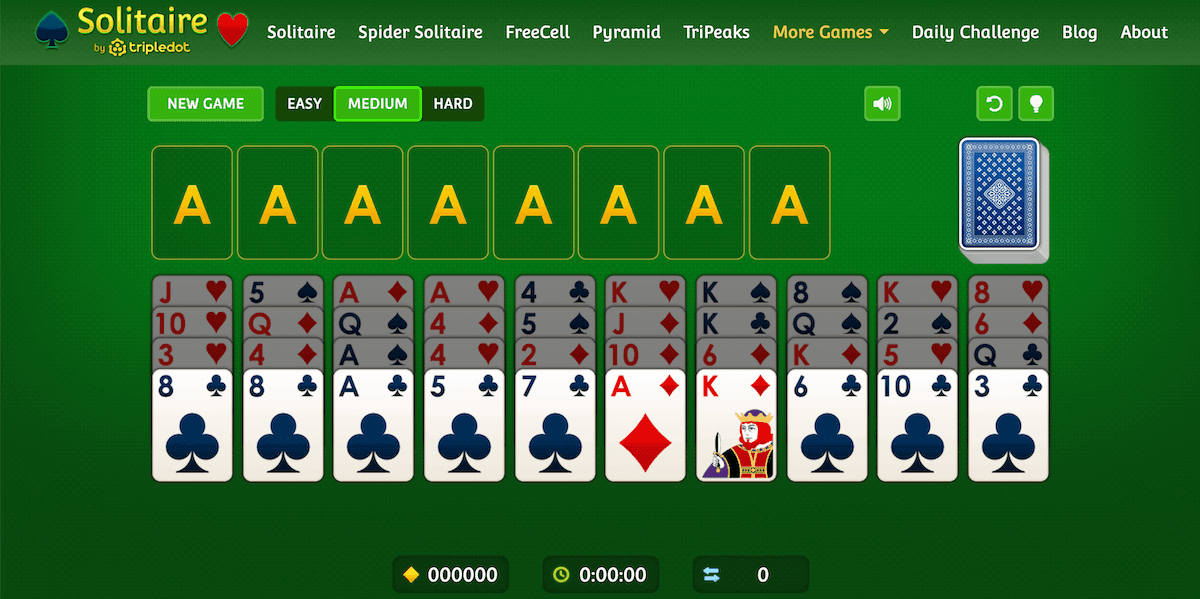
Forty Thieves is won by building all eight Foundation piles, each from Ace to King in a single suit. Each suit has two Foundation piles, since the deck is doubled. Every card starts face-up, so you can see what you are working with. The win rate sits around 10 percent even with strong play under the original one-pass rules, and the redraw on this version lifts it above that.
Forty Thieves Setup and Layout (Two Decks)
Forty Thieves uses two standard 52-card decks for 104 cards total. The board has four areas.
The tableau is the ten-column play area at the bottom of the board. Each column holds four face-up cards, for a total of 40 cards, which is where the game gets its name. The stock pile is the face-down draw pile of 64 cards. The waste pile holds cards you draw but have not yet played. The eight Foundation piles sit above the tableau and start empty.
Forty Thieves Rules and Allowed Moves
Forty Thieves has tight rules that make every move matter. You build tableau columns in descending order by the same suit. For example, the 5♥ goes on the 6♥, not on the 6♦.
You can only move one card at a time, even when a column looks like a clean sequence. You draw one card at a time from the stock pile to the waste pile, and when the stock empties you can redraw and work through it again in the same order. The top waste pile card can move to the tableau or to a Foundation. Any card can fill an empty tableau column, which makes empty columns valuable.
How to Play Forty Thieves Step-by-Step
Learning how to play Forty Thieves Solitaire follows a clear loop. Every step needs a plan.
First, scan all ten columns and move any visible Ace to a Foundation. Next, look for same-suit pairs that can be sequenced on the tableau. Then draw from the stock pile only when no tableau moves remain. Play each waste pile card carefully, and treat the first trip through the stock as reconnaissance for the second. Keep going until the Foundations are complete.
Forty Thieves Strategy and Tips
Winning Forty Thieves comes down to planning a few moves ahead. The single-card rule punishes rushed play.
Work to empty a column early. Empty columns are your most flexible resource because any card can move there. This gives you more options when the tableau becomes crowded. Next, send waste-pile cards straight to the Foundations whenever possible, rather than cluttering the tableau. Then keep tableau sequences short, since long same-suit runs trap the cards below. The hint button finds a legal move when you are stuck. Undo is unlimited, though undoing a stock draw costs 2 points and takes back any points the undone move earned.
Why Forty Thieves Is So Hard to Win
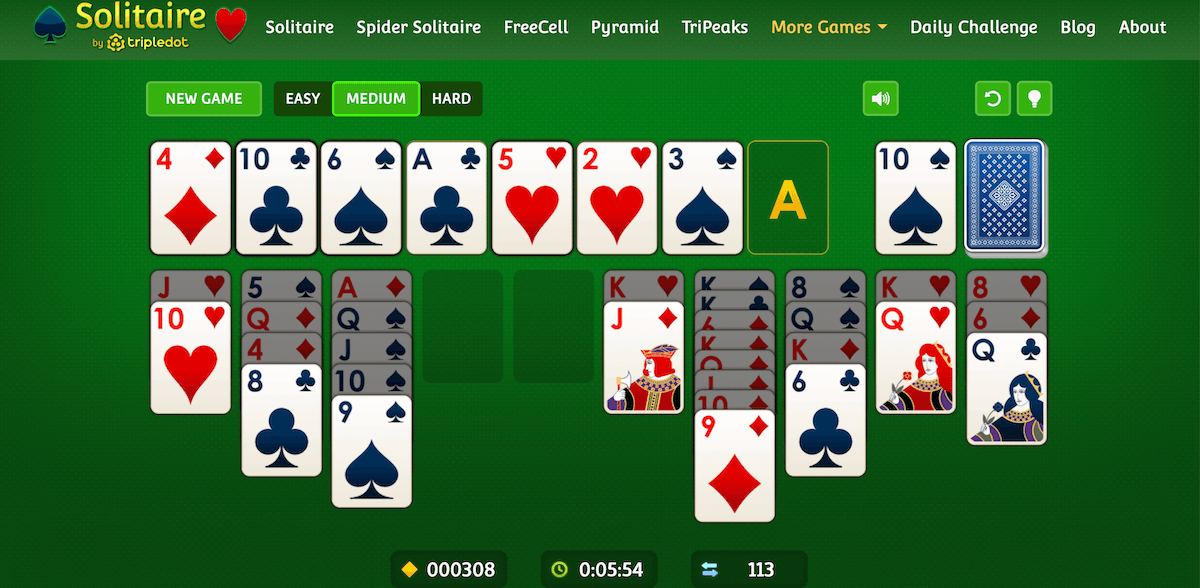
Forty Thieves is hard for three reasons. The first is the single-card movement rule, which means you cannot relocate sequences in one move. The second is the same-suit tableau rule, which gives far fewer matches than alternating colors. The third, in the original game, is the single stock pile pass, which leaves no room for second chances. This version drops that rule and lets you redraw the stock. If you want it back, play Forty Thieves Hard.
Together, these rules turn most deals into careful puzzles. Some deals lock up early, no matter what you do. For more on game difficulty, see our ranking of the hardest solitaire games.
Forty Thieves Win Rate and Scoring
Forty Thieves has a low win rate of around 10 percent with careful play under the original rules, and the redraw here improves on that. Casual play wins far less. Most games take 20 to 30 minutes, since every move needs thought.
Solitaire.com uses classic scoring rather than Vegas-style wagering. This lets you focus on clean play instead of money. The Daily Challenge offers a fresh puzzle each day. To compare difficulty across games, browse our list of types of solitaire games.
Easier Forty Thieves Variations
If Forty Thieves feels too punishing, several easier variations soften the rules. Each keeps the two-deck format but eases one of the strict rules.
Josephine lets you move groups of sequenced cards between columns, and it keeps the stock redraw as well, which makes it the friendliest way into the two-deck format. You can play it here. Rank and File uses alternating colors in the tableau, making it more forgiving than standard Forty Thieves. Both raise the win rate well above standard Forty Thieves, though Rank and File is not currently on Solitaire.com.
For a different kind of two-deck challenge, try Spider Solitaire 4 Suits. For a softer start, Klondike Solitaire and FreeCell are easier picks.
Frequently Asked Questions
How do you play Forty Thieves Solitaire?
You build eight Foundation piles by suit, from Ace to King, using two decks. Tableau columns are built down by the same suit. You move only one card at a time, and when the stockpile empties you can go through it again.
How many decks does Forty Thieves use?
Forty Thieves uses two standard 52-card decks, totaling 104 cards. Each suit has two Foundation piles, since the deck is doubled.
What are the rules of Forty Thieves?
Tableau columns are built in descending order by the same suit. You move one card at a time, never a group. You can pass through the stock pile more than once on this version. Any card may fill an empty tableau column.
Why is Forty Thieves so difficult to win?
Single-card movement and same-suit tableau building limit your options badly, since same-suit runs are far rarer than alternating-color ones. In the original game a single stock pile pass leaves no room for recovery either, which is why Forty Thieves Hard is the toughest of the three versions here.
What's the best strategy for Forty Thieves?
Empty a column early, since any card can fill it. Send waste pile cards to the Foundations when possible, instead of cluttering the tableau. Keep tableau sequences short to avoid trapping cards.
What is the win rate for Forty Thieves?
The win rate sits around 10 percent with careful play under the original one-pass rules. Casual play wins far less. Even strong players lose more often than they win.