
What Is the Least Amount of Moves to Win Solitaire?

In theory, the least amount of moves to win Klondike Solitaire is 52 if only card placements count. If Stock pile flips are included, the floor is 76 moves for Turn 1 and 60 for Turn 3. The exact number depends on which version you play and how the site counts moves. Many players win in roughly 120-135 moves, though that figure is only an estimate. On Solitaire.com, Stock pile flips, Tableau moves, and Foundation placements each count as one move.
What Counts as a Move in Solitaire?
What counts as a move depends on the site you play on. That is why minimum move numbers vary across the internet.
The following actions each count as one move on most platforms, including Solitaire.com:
- Moving a card from the Tableau (the seven columns of cards) to a Foundation pile (the four piles built by suit from Ace to King)
- Flipping a card from the Stock pile (the draw pile) to the Waste pile (the face-up pile)
- Moving a card or a group of cards between Tableau columns
- Moving a card from the Waste pile to the Tableau or Foundation
Revealing a face-down card after the card above it moves does not count as a move. That reveal is automatic and free.
On many platforms the Undo button also counts as a move. If you make a move, undo it, and then make a different move, that can cost three moves in total. The Hint button, however, does not count as a move. Use it freely when you are stuck.
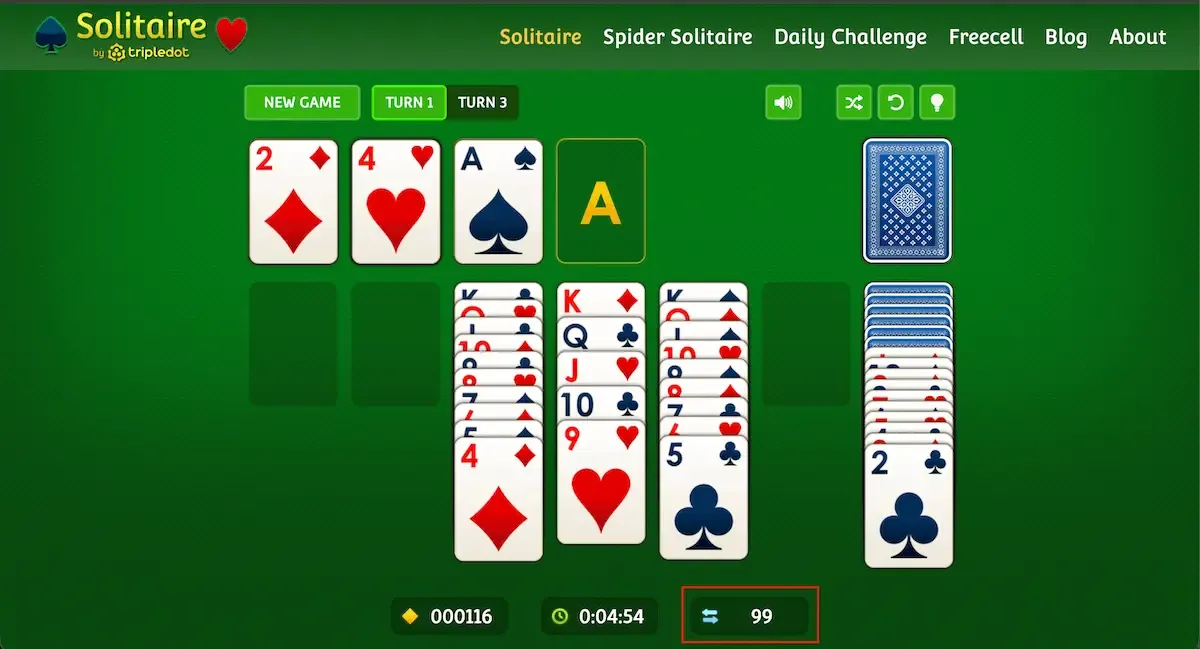
Least Moves to Win Klondike Solitaire
The theoretical minimum number of moves to win Klondike Solitaire is 76 for Turn 1 and 60 for Turn 3, assuming Stock pile flips count as moves and every card goes straight to the Foundation.
Here is how the math breaks down for each version:
Turn 1: 28 Tableau cards move to Foundation + 24 Stock pile flips (one at a time) + 24 Waste pile cards move to Foundation = 76 total moves.
Turn 3: 28 Tableau moves + 8 Stock pile flips (drawing three at a time) + 24 Waste pile plays = 60 total moves.
If Stock pile flips are not counted, the minimum for both versions drops to 52. That is the absolute floor. Every card must reach the Foundation exactly once. You cannot win in fewer than 52 moves because the deck has 52 cards.
The catch is that a perfect game requires every card to go straight to the Foundation without any Tableau rearranging. The odds of getting this deal are astronomically low.
In reality, many players win Klondike in roughly 120-135 moves. Here is a rough, unofficial benchmark based on estimates for how your move count stacks up:
- Under 80 moves: Excellent
- 80 to 100 moves: Strong
- 100 to 120 moves: Average
- 120 to 150 moves: Typical
- Over 150 moves: Room to improve
You can play Klondike Solitaire free on Solitaire.com and track your move count after each game.
Least Moves to Win Spider Solitaire
A rough estimate of the minimum number of moves to win Spider Solitaire (1-Suit) is about 109.
Spider uses two standard decks (104 cards total) spread across ten Tableau columns. To win, you build eight complete King-to-Ace sequences in the same suit. Each completed sequence automatically moves to the Foundation.
The math: 104 card moves to build all eight sequences, plus 5 Stock pile deals that add new cards to the Tableau. That totals about 109 moves. It is a loose lower bound that assumes ideal conditions, so real wins need more.
In practice, many 1-Suit wins take roughly 130 moves. The 4-Suit version is far harder and takes many more moves per win because mixed-suit sequences must be taken apart and rebuilt.
Least Moves to Win FreeCell
The minimum number of moves to win FreeCell is 52.
FreeCell deals all 52 cards face-up across eight Tableau columns. There is no Stock pile. In a perfect game, each card moves directly from the Tableau to a Foundation pile. One move per card. 52 cards. 52 moves.
FreeCell is nearly always winnable. Virtually every deal (about 99.999%) can be solved, according to Wikipedia. A typical winning game takes roughly 85 to 110 moves by a rough estimate. The extra moves come from using the four free cells (temporary holding spots) and rearranging Tableau columns.
Least Moves to Win Pyramid Solitaire
The minimum number of moves to clear Pyramid Solitaire can be as low as 14 and is at most 28, depending on the deal.
Pyramid uses a pairing mechanic instead of sequencing. You remove cards that add up to 13. For example, pair a 5♣ with an 8♦ to clear both. Kings equal 13 on their own and are removed without a partner.
The pyramid layout holds 28 cards. If every pair sits inside the pyramid itself, you can clear it in as few as 14 to 16 moves: one move per pair, plus one move for each King. If every card needs a partner from the Stock pile, it takes up to 28 moves.
Winning games often take roughly 49 to 70 moves because the Stock pile is needed more often than not. Standard one-pass Pyramid is also one of the hardest solitaire variants to win, with solver estimates in the single digits.
Does Move Count Affect Your Score?
Yes. Fewer moves generally lead to a higher score in classic scoring.
On Solitaire.com, classic scoring awards points for each card placed on a Foundation pile. Points are deducted for cycling through the Stock pile, so extra flips reduce your final score. The Undo button also costs points on most platforms.
The most efficient path (fewest moves, fewest Stock pile cycles, fewest undos) produces the highest score.
For a deeper breakdown, see how the solitaire scoring system works.
Tips to Reduce Your Move Count
Reducing your move count comes down to avoiding wasted moves, not playing faster.
Send cards to the Foundation first: If a card can go directly to a Foundation pile, place it there. Moving it to another Tableau column first, then to the Foundation, costs two moves instead of one.
Uncover face-down cards before using the Stock pile: Revealing a face-down card in the Tableau does not count as a move. Flipping a Stock pile card does. Prioritize the free reveals.
Do not empty a column without a King ready: Moving the last card from a column wastes a move if you cannot immediately place a King in that space. Only Kings can fill empty Tableau columns.
Check the Waste pile after every Stock pile draw: If you play the top Waste pile card and a useful card appears underneath, play that one too. Cycling back through the Stock pile later to find it adds unnecessary moves.
Use Undo sparingly: On many platforms each undo adds a move and can cost points. On Solitaire.com, there is no time penalty. Take a moment to think before you act. For more strategy tips, see how to win Solitaire.
Frequently Asked Questions
Is 120 moves a good score in Klondike Solitaire?
Yes. Many players win Klondike in roughly 120-135 moves. Finishing under 100 is excellent. Under 80 is rare and requires both a favorable deal and a strong strategy.
Is a perfect game of Solitaire possible?
In theory, yes. A perfect game means every card goes straight to the Foundation in 52 moves. In practice, the odds of getting this deal are nearly zero. Even experienced players rarely finish with fewer than 100 moves.