
Scorpion Solitaire Strategy: How to Win More Games
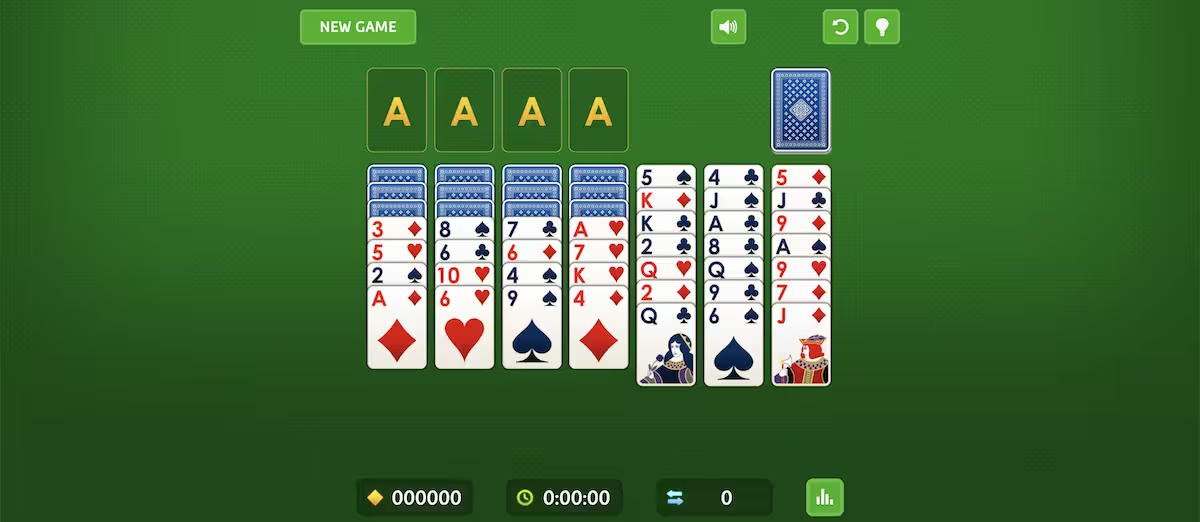
Scorpion Solitaire has a win rate of about 6 percent. The order of your first few moves decides most games. The strategy comes down to three habits.
Free the 12 face-down cards on the left before anything else. Keep Kings and empty columns for each other. Save the three-card stock pile deal until you have no other move.
This guide recaps the Scorpion Solitaire rules in a minute and explains why the game is so hard. Then it walks through a sample opening move by move.
Scorpion Solitaire in 60 Seconds (Rules Recap)
Scorpion Solitaire uses one 52-card deck dealt into seven tableau columns. The tableau is the set of seven card stacks on the table, with seven cards in each column. The first four columns start with three face-down cards at the bottom. That makes 12 face-down cards in total.
The last three cards form the stock pile, a small reserve set aside at the start. You deal it once, face-up, onto the first three columns.
You build down in the same suit, so a 6♠ goes only on a 7♠. You can move any face-up card together with every card stacked on top of it. Those cards do not need to be in order.
Only a King can fill an empty column. The goal is four complete runs from King to Ace, each in a single suit.
The group-move rule is borrowed from Yukon, and the goal of building King-to-Ace runs in one suit comes from Spider. If you know either game, Scorpion will feel familiar. For the full Yukon version of the rule, see our guide to Yukon Solitaire rules.
Why Scorpion Is So Hard to Win
Scorpion is hard because every helpful rule has a built-in trap. The win rate sits near 6 percent, which makes Scorpion one of the most difficult solitaire games. See how it compares in our ranking of the hardest solitaire games.
Four things make it hard:
- Same-suit building means a 6♥ cannot go on a 7♠, so most cards have only one legal home.
- Twelve cards start face-down, and you cannot plan around what you cannot see.
- The stock pile holds just three cards and lands only once.
- Group moves let you bury a card you need under cards you do not, and the game never warns you.
Start on the Left: Freeing the 12 Face-Down Cards
Your first goal in every Scorpion game is to flip the 12 face-down cards in columns one through four. Each one is unknown information, and any of them could be the Ace or King that unlocks the board. The three columns on the right are fully face-up, so they can wait.
To flip a face-down card, you must move every face-up card above it. That usually means moving a whole group at once. Look at the lowest face-up card in each left column. Find one with a same-suit partner exposed somewhere else.
For example, column 2 shows a 9♦ at the bottom of its face-up cards. A 10♦ sits on top of column 6. Move the 9♦ group onto the 10♦, and the first face-down card in column 2 flips.
Kings and Empty Columns
Kings and empty columns belong together, because a King is the only card that can fill an empty column. A King sitting in the middle of a column is a wall. Nothing can be placed on it except a Queen of the same suit. It cannot move anywhere until a column opens up.
Plan your empty columns around the Kings you can see. If you empty a column with no King ready, the column sits idle. An idle column is a wasted resource.
The strong sequence is to spot a reachable King, clear a column, and move the King in. Then build the run down from there.
Why Aces Can Block a Whole Column
An Ace is the lowest card, so nothing can ever be placed on it. When an Ace sits on top of a column, that column is frozen until the Ace moves. The Ace can move only onto the 2 of its own suit. That 2 must be the top card of another column.
This is why experienced players treat an exposed Ace as a warning, not a win. If the 2♣ is buried under other cards, an A♣ sitting on top of a column stays stuck, and the cards under it stay locked. Before you move a group that puts an Ace on top, check where its 2 is. If the 2 is not reachable, find another move.
A Sample Opening, Move by Move
Here is a four-move opening that shows the habits above in order. Use this pattern on your own deals, even when the exact cards differ.
- Column 6 has a 9♦ on top. Column 2 shows an 8♦ as its lowest face-up card, with three cards above it. Move the 8♦ group onto the 9♦. All four face-up cards leave column 2, and its first face-down card flips.
- The flipped card is a Q♣. Column 7 has a K♣ on top. Move the Q♣ onto the K♣. The second face-down card in column 2 flips.
- The new card is a 5♠. Column 4 has a 6♠ on top. Move the 5♠ onto the 6♠. Column 2 now shows its last face-down card.
- That card is a K♥. Column 2 is now a single King on an otherwise empty column, which is exactly where a King belongs. Build down on it with the Q♥ when it appears.
Notice that the stock pile has not been touched. Save it for the moment no legal move remains.
Play Scorpion Solitaire Free Online
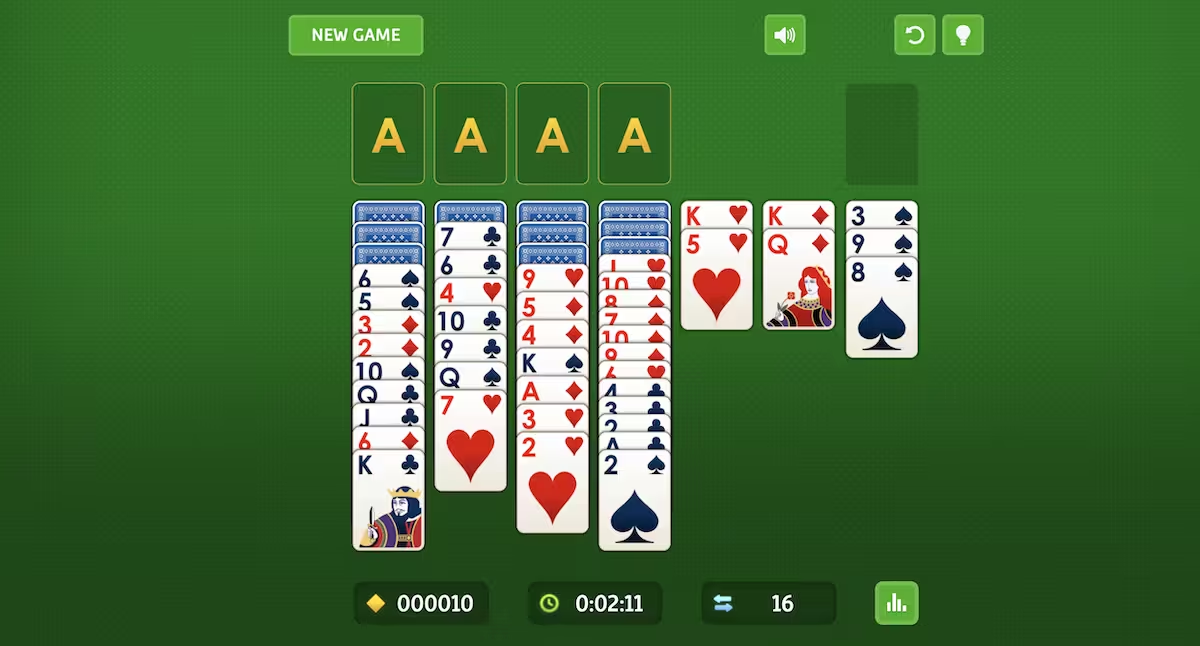
Ready to put these tips into practice? You can play Scorpion Solitaire for free at Solitaire.com, with no downloads and no sign-up required. Unlimited undo lets you test a move and take it back if it buries a card you need. The hint button finds a legal move when you are stuck, and classic scoring tracks your progress without Vegas-style wagering.
Other Scorpion-style games you may see online:
- Easy Scorpion Solitaire hides fewer cards, with three face-down cards in each of the first three columns, and lets any card fill an empty column.
- Double Scorpion Solitaire uses two decks and ten columns for a longer game.
- Scorpion Spider Solitaire is not a separate game. Some sites list Scorpion and its variants as Spider-type games, since both aim for same-suit King-to-Ace runs, like Spider Solitaire.
If you want the same King-to-Ace goal with a stock pile that deals more often, read our guide on how to play Spider Solitaire. If you want the group-move rule without the same-suit limit, try Yukon Solitaire. Even experts lose most Scorpion games, so a win is worth the patience.