
Two-Deck Solitaire Games You Should Try
Spider Solitaire is the most popular two-deck solitaire game. Two-deck games use 104 cards instead of 52, which gives you bigger boards, longer sessions, and deeper strategy. This guide ranks the top two-deck games by difficulty and where each one fits. Three are free at Solitaire.com right now. Others are worth knowing for when you want to explore further.
Quick picks before you scroll:
- Best for beginners: Spider Solitaire 1-Suit
- Best challenge: Spider Solitaire 4-Suit and Forty Thieves
- Best for Klondike fans: Double Klondike
- Most distinctive layout: Crescent Solitaire
Why Play Solitaire With Two Decks?
Two-deck solitaire games reward planning more than luck. The larger board holds twice as many cards, so every move has more downstream effects. You have more room to sort, more space to plan, and more time to enjoy each session.
Many players step up to two-deck games once they have won plenty of single-deck rounds. The strategy carries over, but the pace and scale change. If you already enjoy Klondike or FreeCell, a two-deck game is the natural next step.
Spider Solitaire
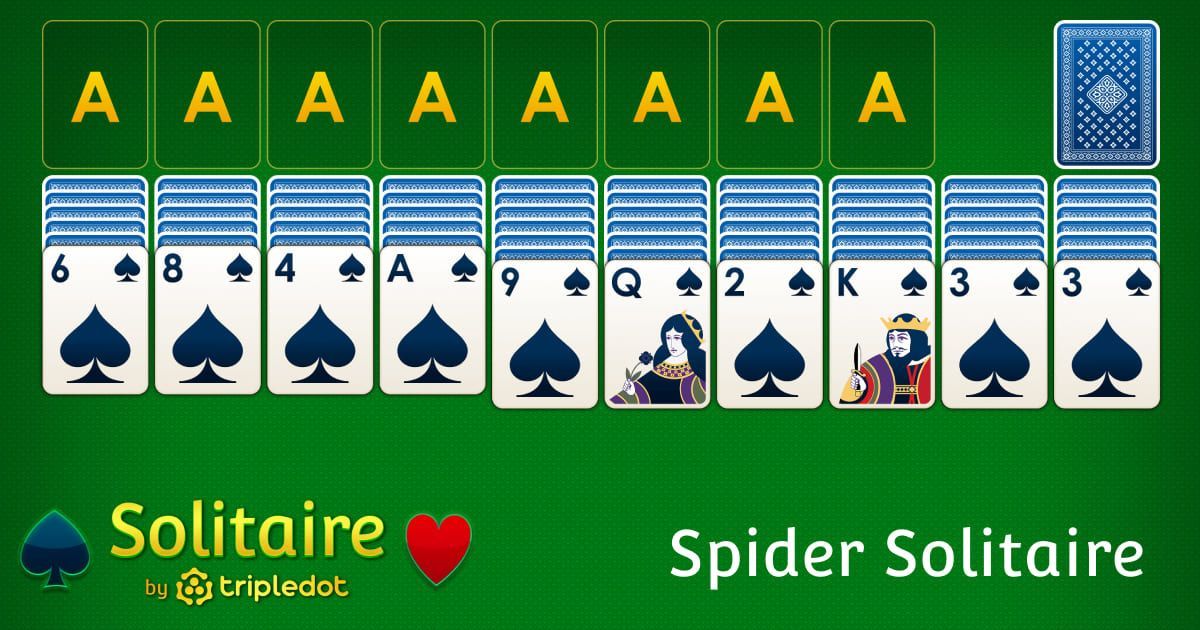
Spider Solitaire is the most popular two-deck game, and it is the only two-deck game on Solitaire.com right now. You use 104 cards across ten tableau columns and build eight complete same-suit sequences from King to Ace. Each finished sequence moves to the foundation on its own.
The three difficulty tiers make Spider the smart starting point. Beginners can enjoy Spider Solitaire 1-suit, which has a win rate around 80 percent. Spider Solitaire 2 Suits mixes Spades and Hearts for a middle challenge. Spider Solitaire 4 Suits is one of the harder solitaire games ever built, with a win rate below 10 percent.
Forty Thieves
Forty Thieves is the ultimate planning test in the two-deck category. The board deals 40 face-up cards across ten columns of four, and the remaining 64 form the stock pile.
Three strict rules make it hard. You can move only one card at a time, no matter how neat a column looks. You cycle the stock pile only once. Tableau columns are built down by the same suit, not alternating colors. The win rate sits around 10 percent even with careful play. Forty Thieves is not yet on Solitaire.com, but the difficulty makes it a rewarding target for planning-focused players.
Double Klondike
Double Klondike is the two-deck version of standard Klondike, spread across nine or ten tableau columns. Some players search for it as Klondike Solitaire 2 Decks, but it is the same game either way. You still build foundation piles by suit from Ace to King. The doubled deck means eight foundations to complete instead of four.
A naming caution first. Double Klondike is a solo game, not the same as two-player Double Solitaire. The two-player game is a head-to-head race that also uses two decks. This solo version keeps standard Klondike rules and adds a bigger board. Double Klondike is not currently on Solitaire.com, but Klondike fans should try it when they want more of the same game.
Crescent Solitaire
Crescent Solitaire earns its spot with the most distinctive layout of any two-deck game. Sixteen small piles are arranged in a crescent shape around the center of the board. Each pile holds six cards. Eight foundation piles sit in the middle.
The layout is not the only twist. Four foundations build up from Ace, and four foundations build down from King. You plan every move in two directions at once, which few other solitaire games ask of you. The win rate is low, typically in the single digits. Crescent is not currently on Solitaire.com, but the dual-direction foundations make it worth trying.
More Two-Deck Games Worth Knowing
Several other two-deck games sit outside the big four but reward a look.
Josephine, also called Streets, plays like Forty Thieves with easier group-move rules. Rank and File adds alternating-color tableau builds to the same layout. Both raise the win rate compared to standard Forty Thieves. Napoleon at St Helena is another two-deck game tied to history. It is said to have been played during Napoleon's exile. For the difficulty-focused reader, our ranking of the hardest solitaire games shows where these fit.
How Two Decks Change Solitaire Strategy
Two decks change your strategy in three clear ways. The first is depth. With 104 cards on the board, every choice touches more of the game. The second is column management. Bigger boards mean more columns to track, and mistakes stack up faster.
The third change is stock discipline. Most two-deck games give you only one or a limited number of stock passes. Planning around limited card access becomes central. In short, two-deck games reward players who think several moves ahead. They punish rushed play harder than single-deck games do.
Play Two-Deck Solitaire Free Online
Your fastest path to a two-deck game is Spider Solitaire on Solitaire.com. The three difficulty tiers are free, with no downloads, no signup, and no disruptive ads.
If you are new to two-deck play, start with Spider 1-Suit. If you have mastered that, step up to 2-Suit. If you want the deepest challenge on the site, take on 4-Suit. Use Unlimited Undo to test a different order without restarting. Use the hint button when you are stuck. All modes use classic scoring. When Forty Thieves and Crescent launch on Solitaire.com, this guide will point you straight to them.